Showing posts with label project: Egypt. Show all posts

Monday, November 14, 2016

Chapter 2 (Ancient Egypt): Summary

Chapter 2:  Ancient Egypt and Kush (Summary)

The Nile Valley was where most of Egypt was. The civilization started when travelers in Africa, thousands of years ago in the desert, found the Nile and started to settle.

Egypt’s empire was first chiefs or great war heroes. The chief’s son or daughter became rules after they dies. The rulers of Egypt got more powerful as the civilization grew larger into a city until they were believed to be gods on Earth. Egyptians believed in many gods.


Nubia had strong armies and were a strong city. Kush ruled Egypt for a short amount of time before falling. When Nubia did rule, they adopted lots of Egyptian culture.

Ancient Egypt Quiz

1. What natural barriers protected Egypt from invasion?
            It was so hot nobody could live through the heat.
2. What were the Egyptians’ religious beliefs?
            The sphinx had magic powers.
3. How did Akhenaton upset the traditional order in Egypt?
            He tried to change the culture.
4. Who were the Nubians?
            The Nubians were the Kush who were strong people in Upper Egypt.
5. Identify the four social groups in ancient Egypt and explain who belonged to each group.
6. What events led up to the Kushite conquest of Egypt?

The Kushite loved Egyptian culture and were angered by Egypt capturing them.

Saturday, October 15, 2016

Compare and Contrast Pharaohs

Compare and contrast the rule of Hatshepsut and Ramses II.


Akhenaton

How did Akhenaton upset the traditional order in Egypt?


Akhenaton tried to change Egypt’s culture and religion.

Pharaoh's Letter

Suppose you are an Egyptian pharaoh who wants a pyramid built to house your tomb. Write a letter to the farmers and workers in your kingdom explaining why it is their duty to build the pyramid for you.


Farmers and workers, I would like a pyramid to be built for as you all know for me to be passed on to the underworld, I must get a tomb. If you build the tomb, you will get half a pound of gold. Work begins in 15 moons.

Pharaoh’s Signature Royal Seal

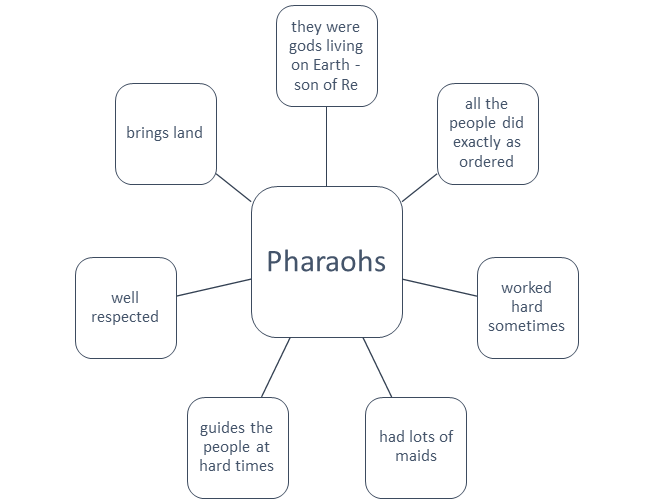
Pharaohs

Fill in details about the pharaohs of the Old Kingdom and their duties.


Nile River Valley

How did the geography of the Nile River Valley lead to the growth of a civilization there? 1 paragraph

People were traveling through the desert and found the Nile. People made towns and villages along the shore of the Nile. The Nile served for water and helped grow crops.

Sunday, May 29, 2016

The Study of Mummies

My group's scientist is an archaeologist. This scientist could investigate where a mummy comes from in the world. A question an archeologist would ask is: Where in the world did the mummy come from? This would help an archeologist understand what its culture may have been, how the mummy may have lived, what it wore, and what it ate.

To know where a mummy was found, scientists take good notes about where a mummy is found in the field. If you don't know where a mummy was found, you could also look at how the mummy was made because different mummies are made in different ways in different areas. Archaeologists use grids to divide the study area to describe where remains are found. Archaeologists can also use computers and 3-D imaging to model the mummy and see how it was made. For example, in the Nova video, The Emperor's Ghost Army, scientists used 3-D images to remodel missing pieces of artifacts.

Archaeologists are sometimes challenged when they find new evidence that has never before been discovered. To investigate the new evidence they would look at all of the artifacts found in the environment to help understand the new culture. They could also look for similar artifacts in the surrounding area because the groups may have been similar.

Archeologist may never know for sure where a mummy comes from because there could always be new evidence that adds new understanding. For example, we could learn that mummies were moved over time. Or, technology in the future might help us better understand human history. 


Saturday, April 9, 2016

The Wet Nurse of King Tut

Zivie, an archaeologist, found a chamber for a woman of ancient Egypt which is very rare. The mummy's name was Maya and with the hieroglyphs Maya was found to be King Tut's wet nurse. A  wet nurse is a woman who feeds another woman's newborn baby. This discovery is a big part of history's puzzles getting put together.

Maya was not found in the Valley of the Kings where most pharaohs are buried. She was buried where only very important mummies were buried. Many people think that Tut's sister was his wet nurse.

To identify the mummy, you compare pieces of the mummy that fell off with pieces of the mummy itself to make sure that the mummy in the coffin is really the mummy that is written on the coffin. Why you might have to do this is because a long time ago, lots of people only wanted to steal the coffin and not the mummy so they would move the mummy to another coffin. Since the mummies might be swapped, you would want to analyze the mummy and the coffin.

For more information:
http://video.nationalgeographic.com/video/king-tuts-wet-nurse


Saturday, January 9, 2016

King Tut

I went to a King Tut exhibit for a field trip. I knew all of the stuff there already but it was cool to see all the things I've heard of and seen in pictures in person! My favorite part was an Egyptian game I knew how to play there! That was so cool! That field trip was the best ever!